Research-backed calculator guide
How to Calculate AI Agent Cost per Month
Learn how to estimate monthly AI agent costs, calculate cost per task and successful task, account for tools and infrastructure, and reconcile estimates with real usage.
Quick answer
To calculate AI agent cost per month, estimate the cost of one complete task, multiply it by the number of monthly tasks, then add fixed platform, infrastructure, observability, retrieval, and human-review costs:
Monthly AI agent cost = fixed monthly costs + (monthly tasks × cost per attempted task) + other usage costs
For a more honest unit metric, divide the end-to-end cost of an attempted task by the percentage of attempts that achieve the required outcome:
Cost per successful task = cost per attempted task ÷ success rate
The important word is complete. An agent task can include model calls, retrieved context, tool results, retries, APIs, storage, and orchestration. A token price by itself is not a monthly budget. AWS’s guidance makes the same point: spend depends on steps, context growth, tools, and call frequency [8].
Use the AI agent cost calculator to create a first estimate, then reconcile it against actual provider and infrastructure usage after launch.
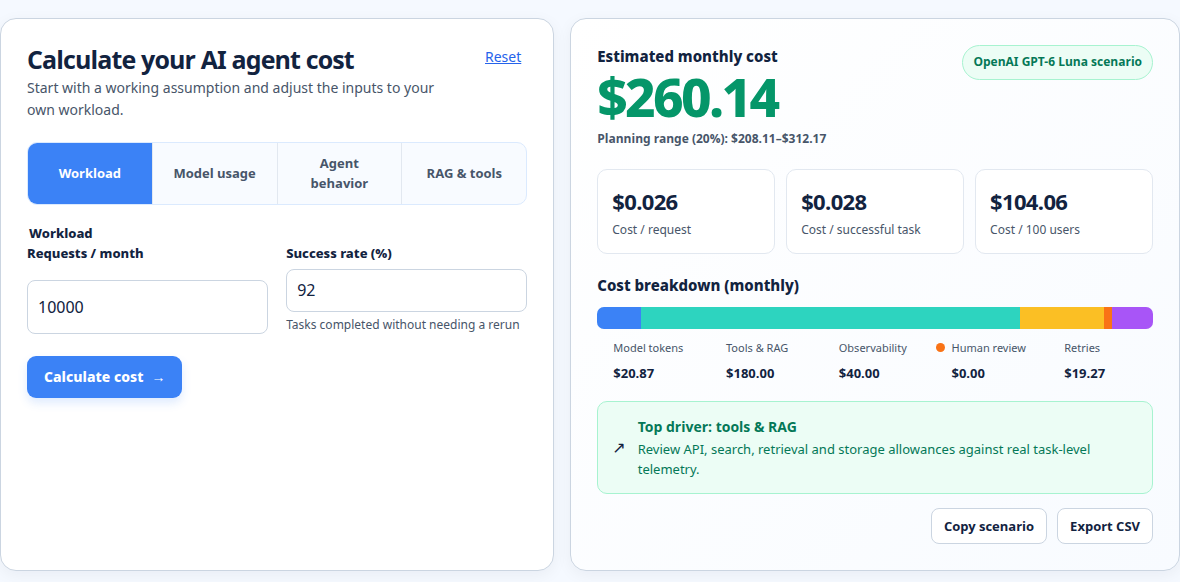
What an AI agent cost calculator measures
An AI agent cost calculator converts operational assumptions into a monthly estimate. The useful inputs are not limited to “which model are you using?” A practical calculator should let you describe the workload around the model.
Workload volume
Start with monthly tasks, not monthly visitors or prompts. Define one task as a measurable unit of work, such as resolving one support ticket, classifying one invoice, completing one research brief, or producing one approved sales summary. If one user conversation can contain several tasks, count the tasks separately or document the conversion rule.
If you only know daily volume, multiply average daily tasks by operating days. For a seven-day service, a simple estimate is daily tasks × 30. Microsoft recommends using recent volumes, testing low, medium, and high scenarios, and comparing estimates with actual consumption rather than treating an estimate as a quote [2].
Model calls and token usage
An agent may call a model once to plan, again to select a tool, again after receiving a tool result, and again to produce the final answer. Each call can send input tokens and generate output tokens. Later calls may also include a longer conversation history, tool definitions, or retrieved documents.
Track average input and output tokens per model call, plus average calls per task. If steps use different models, calculate each route separately. First-party pricing pages distinguish input, cached input, output, batch or priority processing, and built-in tools [3] [4] [5]. Store rates with an “as of” date and re-check them before approving a budget.
Tools, retrieval, and external services
Add costs for web search, browser sessions, code execution, database queries, vector search, embeddings, reranking, file storage, email or messaging APIs, and other paid actions. Some tools are billed per call, some per item, some by compute time, and some through a subscription or platform tier.
Retrieval deserves its own line. A RAG workflow can incur embedding costs during ingestion, vector database storage, retrieval queries, reranking, and additional model input tokens when documents are inserted into the context. Estimate these inputs with the RAG cost calculator instead of assuming retrieval is free.
Fixed platform and operating costs
Include any monthly platform subscription, dedicated runtime, database minimum, queue, monitoring, logging, security, or reserved capacity charge that remains when volume is low. Allocate shared services consistently, such as by task count, compute time, or token volume.
Observability is part of the operating model. Traces, logs, evaluations, dashboards, and retained payloads can create storage and processing costs. For a more detailed allocation, use the observability cost calculator.
The formula
A reusable monthly model has four layers:
Monthly cost = F + (T × A × M) + (T × V) + H
Where:
- F = fixed monthly platform and infrastructure costs.
- T = monthly tasks.
- A = average attempts per task, including ordinary retries. If every task is attempted once, this is 1. If 8% of tasks need one additional attempt, it is approximately 1.08.
- M = average model cost per attempt, including all model calls in that attempt.
- V = variable non-model cost per task, such as tools, retrieval, data transfer, and allocated runtime.
- H = optional human review, exception handling, or quality-control cost.
For a single model call, model cost is:
Model cost per call = (input tokens ÷ 1,000,000 × input price) + (output tokens ÷ 1,000,000 × output price)
For an agent with multiple calls:
Model cost per attempt = sum of model cost per call across every step and model route
Do not hide retries inside a vague contingency percentage. Measure normal retries as part of the average attempt rate, then keep an additional budget buffer for seasonality, provider changes, and unexpected spikes. Microsoft’s estimator guidance suggests a 10–20% buffer for forecast variance [2]; treat that as a planning choice, not a universal rule.
Worked example: a support agent
Suppose a support agent handles 10,000 tasks per month. Each end-to-end attempt uses an average of four model calls. Across those calls, the task consumes 24,000 input tokens and 4,000 output tokens in total. This is an illustrative calculation, not a quote from any provider.
Assume the selected model rate is $2 per million input tokens and $8 per million output tokens. The model portion is:
- Input: 24,000 ÷ 1,000,000 × $2 = $0.048 per attempt.
- Output: 4,000 ÷ 1,000,000 × $8 = $0.032 per attempt.
- Model cost: $0.080 per attempt.
Now add $0.025 for tools and retrieval, $0.015 for allocated runtime and observability, and $0.010 for average retry overhead. The attempted-task cost is:
$0.080 + $0.025 + $0.015 + $0.010 = $0.130
Variable monthly run cost is therefore:
10,000 × $0.130 = $1,300
Assume fixed platform and database costs of $220 per month. The estimated monthly run cost before human review is:
$220 + $1,300 = $1,520 per month
If the agent succeeds on 92% of tasks, cost per successful task is:
$0.130 ÷ 0.92 = $0.1413, or about 14 cents per successful task
That denominator changes the decision. A cheaper configuration costing $0.095 per attempt but succeeding only 70% of the time costs about $0.1357 per successful task before human correction. Define “success” before comparing models: for support, it might require a correct answer plus a correctly updated ticket.
Assumptions and exclusions
A useful estimate states what it includes. Write down these assumptions next to the result:
- Volume: average tasks per month, operating days, seasonality, and growth scenario.
- Agent path: average model calls, tool calls, retrieval calls, output length, and retry rate.
- Pricing: provider, model, region, currency, service tier, cache treatment, and the date the rates were checked.
- Shared services: how databases, runtime, monitoring, and storage are allocated across agents.
- Quality: the success definition, measured success rate, and expected human-review rate.
- Buffer: the percentage reserved for variance, not used to conceal unknown inputs.
Run cost is not build cost. This formula estimates operation after launch; discovery, prompt engineering, integration, evaluation creation, security review, migration, tax, and fully loaded labor need separate lines for total cost of ownership.
Also decide whether subscriptions are included. A team seat or enterprise platform fee may be a real cash cost but not a variable cost per task. Keep it in F unless the contract charges by usage. Current first-party documentation reinforces that model/API usage and consumer or business subscriptions can be separate billing systems [3] [4].
Common mistakes that make estimates too low
Pricing one prompt instead of one task
A prompt-and-answer test hides planning, tool selection, retries, and final synthesis. Measure the full trace from task start to accepted outcome.
Counting only output tokens
Input tokens include system instructions, tool schemas, conversation history, retrieved chunks, and tool results. An agent with short answers can still be input-heavy. Some provider documentation also counts thinking or tool-related instructions in particular billing paths [5].
Assuming one task equals one attempt
Failures, timeouts, malformed tool calls, and human-requested reruns consume resources. Measure attempts per task from traces rather than setting it to 1 because the happy path is cleaner.
Treating success as a cosmetic score
A fluent answer can still be wrong, incomplete, or operationally useless. Use a workflow-specific acceptance rule and evaluate outcomes. Cost per successful task is more informative than cost per attempt when quality differs.
Leaving retrieval and observability out
A RAG index, reranker, browser tool, trace store, or evaluation job may sit on a different invoice from the model. Reconcile all of them before declaring a monthly cost.
Copying a price that will change
Provider pricing pages change models, tiers, regions, discounts, and tool fees. Record the rate date and link to first-party documentation. Never turn a temporary promotional rate into a permanent forecast.
How to optimize and reconcile the estimate
Start with low, expected, and high scenarios. Change task volume, calls per task, token totals, success rate, and tool usage to see what drives the budget.
Then instrument production. For each run, capture an agent identifier, workflow name, model and provider, input and output tokens, tool calls, retries, latency, outcome status, and any human handoff. Join that trace data to provider invoices and infrastructure billing. The invoice reconciliation guide can help you map usage records to billed amounts without mixing estimates and actuals.
Compare estimated and actual cost at the same level of detail. If the invoice is higher, ask which input changed: more tasks, longer context, a model route, extra retries, or a shared service allocation. If quality fell, recalculate cost per successful task rather than celebrating a lower cost per attempt.
Optimize the dominant line item. Trim verbose tool results when input tokens dominate; route simple steps to a cheaper model when evaluations support it; cache repeated context when the economics work; and set step, time, and spend limits. For non-interactive work, investigate batch or lower-priority processing [3] [5].
Finally, review the model quarterly or whenever volume, prompts, tools, or provider rates change. Keep the assumptions versioned. The methodology page is useful for documenting definitions, allocation rules, and update dates so finance and engineering use the same denominator.
FAQ
What is the simplest AI agent cost formula?
Multiply monthly tasks by the average end-to-end cost per attempted task, then add fixed monthly costs. End-to-end cost should include every model call, normal retry, tool or retrieval charge, and allocated infrastructure cost.
How do I calculate AI agent cost per month from token prices?
Sum input-token cost and output-token cost for every model call in one task. Multiply that model total by monthly attempts, then add tools, retrieval, infrastructure, observability, and fixed platform charges. Use actual rates for your provider and record the date checked.
What is cost per successful task?
It is the cost per attempted task divided by the success rate. For example, a $0.20 attempt with an 80% success rate costs $0.25 per successful task, before any separate human correction cost.
Should I include retries in the estimate?
Yes. Include ordinary retries in the average attempts-per-task factor or in the measured end-to-end trace cost. Keep a separate contingency buffer for unusual incidents and seasonality.
Are AI agent subscriptions and API costs the same?
No. A seat or platform subscription can be a fixed cost, while API or credit usage may be metered separately. Check the provider’s billing documentation and place each charge in the fixed or variable part of your model.
How often should I update an AI agent cost estimate?
Update it when the model, prompt, tools, retrieval setup, traffic, or pricing changes. A quarterly review is a reasonable operating rhythm, with monthly reconciliation once the agent is in production.
Open the calculator
Build a defensible estimate with your own task volume, token usage, success rate, tool calls, fixed charges, and infrastructure assumptions. Then compare the result with the first full month of observed usage.
Run your scenario
Turn this framework into an editable estimate.
Use dated, source-linked assumptions and see cost per request, successful task and month.
Related internal tools
- AI agent cost calculator for task-level and monthly estimates.
- Invoice reconciliation tool for comparing provider usage with billed totals.
- Observability cost calculator for traces, logs, retention, and evaluation overhead.
- RAG cost calculator for embeddings, retrieval, reranking, storage, and context costs.
- Methodology for definitions, assumptions, and allocation rules.
About the Author
About the Author: Zunair Ali Syed is a doctoral researcher in Management Sciences at Minhaj University Lahore and a research consultant with experience in academic research and editing since 2011. He runs QuickEduHelp, with professional interests in digital learning, research methods, and evidence-based academic support.
Primary sources checked
Pricing and product behavior can change. These sources support the time-sensitive claims in this guide; verify current provider terms before committing spend.