Research-backed calculator guide
AI Agent Development Cost Estimate: Scope, Roles and Run Costs
Estimate AI agent development cost from a scope-based work breakdown, editable role hours and rates, contingency, and separate recurring model and infrastructure costs.
Quick answer
A defensible AI agent development cost estimate is a scope-and-hours model, not a universal price band. Break the project into discovery, data, tools and integrations, application, evaluation, security, and deployment. For each workstream, enter hours and the rate that applies to your team or supplier. Then add a clearly labeled contingency. Keep post-launch model, storage, observability, support, and maintenance costs in a separate monthly run-rate.
For an editable first pass, use:
One-time build cost = Σ(workstream hours × role rate) + contingency + one-time vendor or setup costs Monthly run cost = model usage + tools/retrieval + runtime/storage + observability + support/maintenance + human review
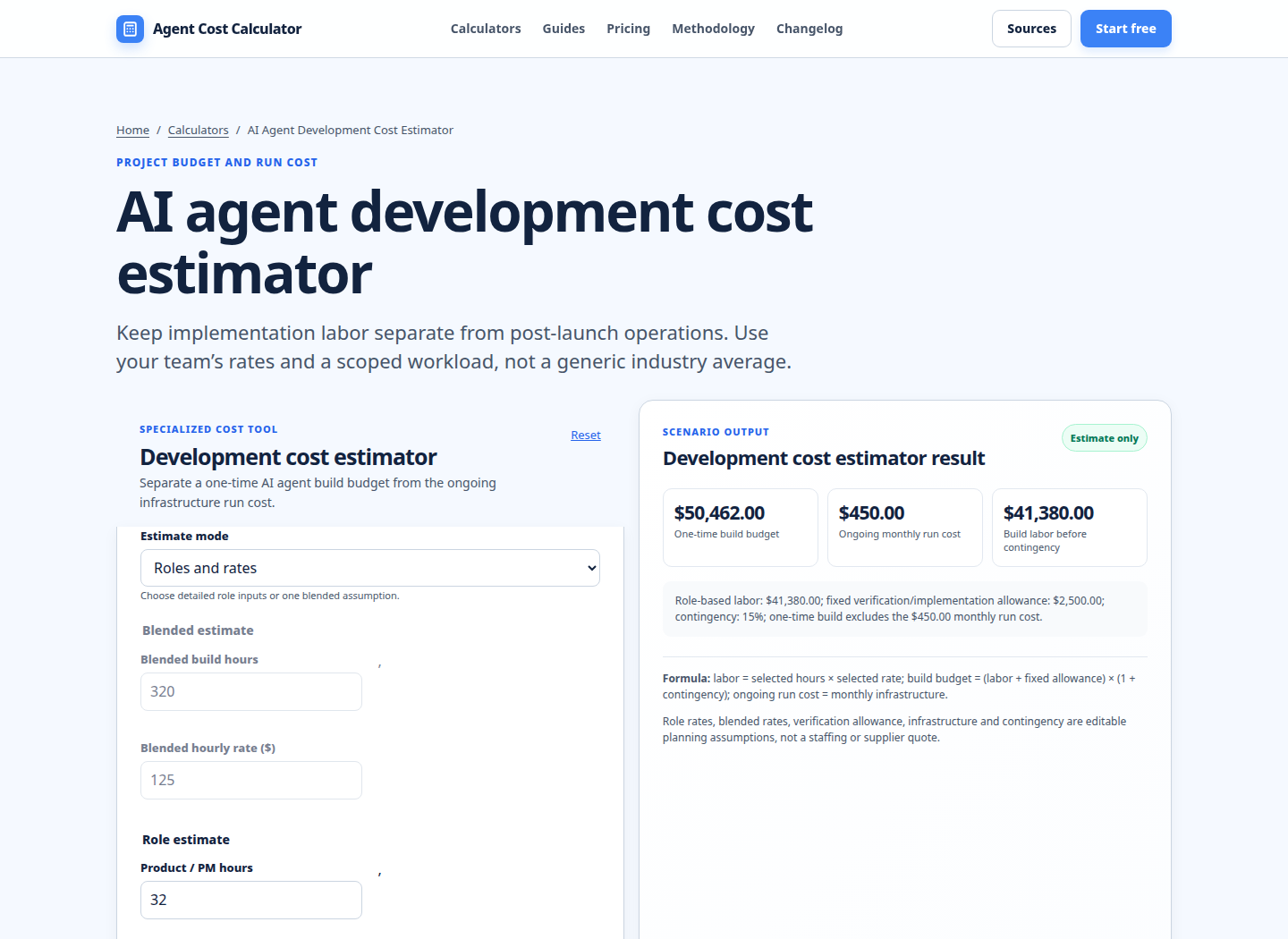
In an illustrative read-only support agent, 448 planned labor hours at role-specific rates produce a $46,320 labor subtotal. A 15% planning buffer makes the one-time estimate $53,268 before one-time vendor costs. A separate example run-rate is $2,706 per month, including an explicitly small model-usage line, infrastructure, observability, support, and maintenance. These are scenario assumptions, not market averages or a vendor quote.
Use the AI Agent Development Cost Estimator to replace the sample hours, rates, usage, and recurring charges with your own assumptions.
What the current search results cover—and what they leave out
A dated, locale-limited snapshot helps define the editorial gap without pretending to measure demand. On 2 November 2026, an English-language web search for “AI agent development cost estimate” returned ten pages led by agency guides, vendor blogs, an AWS Builder community article, and discussion pages. The inspected set included SoftTeco, ProductCrafters, AWS Builder Center, Sparkout, Azilen, Intellectyx, Aalpha, two Reddit pages, and a Facebook page that did not expose usable article content. This is a snapshot of returned pages, not a claim about global rankings or competitor absence.
The dominant format was a long-form pricing article: cost ranges by agent type, complexity, industry, timeline, or build approach. Several used comparison tables and hero graphics. SoftTeco exposed a team calculator, while Sparkout showed an estimator with dropdown-style assumptions and a lead-generation call to action. The AWS Builder page was a broad explanatory guide without a transparent numeric work breakdown. The community pages supplied anecdotal monthly figures rather than auditable project scopes. Freshness varied from July to October 2026, while the older pages generally lacked a clear rate date.
The supportable gap is narrower than “no one answers this.” In the inspected snapshot, pricing ranges were easier to find than a reproducible calculation that multiplies phase hours by editable role rates, keeps contingency separate, and then shows recurring run costs under the same assumptions. The estimator here is designed for that decision. It also makes evaluation, security, and deployment visible instead of treating them as an implied percentage. The underlying topic inventory remains an ideation backlog: no search volume, keyword difficulty, CPC, or demand forecast is asserted here. The site’s small three-month Search Console sample is directional only.
Scope first: define the unit you are budgeting
Before assigning hours, write one sentence that defines the agent’s accepted outcome. “Answers questions” is too vague. “Retrieves an approved policy passage, drafts a response, and routes uncertain cases to a human” is measurable. Record the users, task volume, systems touched, data classes, autonomy level, human checkpoints, environments, and success criteria.
The architecture should follow the smallest system that can meet that outcome. Anthropic distinguishes predictable, code-orchestrated workflows from agents that dynamically choose their process, and recommends adding complexity only when it improves the result [4]. A fixed workflow with one model call may need less implementation and testing than an autonomous loop with retries, memory, and several tools. The estimator therefore asks for scope inputs rather than assigning a “simple” or “complex” label a universal price.
A work breakdown that maps to real deliverables
Discovery and architecture turns the use case into a workflow map, acceptance criteria, data-flow diagram, risk register, and an API/model decision. Include stakeholder interviews, process baselines, prototype spikes, and a decision about whether an agent is necessary. OpenAI’s production guidance treats architecture, scaling, cost management, security, and deployment as separate production concerns [1].
Data and knowledge covers source inventory, permissions, cleaning, chunking, metadata, ingestion, refresh rules, and retrieval tests. If the agent uses proprietary documents, budget for access review and a representative evaluation set. Do not assume that buying a model removes the work of making business data usable.
If retrieval is a material part of the design, use the RAG cost calculator to model embeddings, vector storage, retrieval, and generation separately from labor.
Tools and integrations includes tool schemas, authentication, retries, idempotency, rate-limit handling, error states, audit events, and sandbox connectors. Count each system boundary: CRM read access, ticket write access, search, email, database, and approval queue are not one generic “integration.” Anthropic’s agent guidance emphasizes that tool interfaces need clear documentation and testing, especially when the model selects tools dynamically [4].
Application and experience includes the API or orchestration service, state management, prompt and policy configuration, user interface, streaming, feedback, permissions, and admin controls. A back-office API with no end-user interface is a different scope from a multi-tenant product with seats, billing, and audit views.
Evaluation and QA is a build workstream, not a final checkbox. Create test tasks, expected outcomes, tool-call checks, regression cases, adversarial inputs, load tests, and human review criteria. OpenAI describes evals as a loop of describing the task, running test inputs, analyzing results, and iterating [2]. Anthropic defines a task, trial, grader, transcript, outcome, and evaluation harness separately; those definitions are useful budget units because each can require design and implementation work [5].
Security and privacy covers threat modeling, secret management, identity and access control, tenant isolation, data retention, prompt-injection defenses, logging redaction, dependency review, and any required compliance evidence. OpenAI recommends protecting API keys, separating staging and production, monitoring usage, and addressing data storage, transmission, retention, and secure coding before production [1]. The rate for a security review should be your organization’s actual internal or supplier rate, not an invented market constant.
Deployment and operations includes environments, CI/CD, infrastructure as code, rollback, alerts, dashboards, backups, runbooks, spend limits, and handover. OpenTelemetry describes traces, metrics, and logs as core telemetry signals for instrumenting and operating systems [6]. If you cannot see task outcome, model, tokens, tool calls, retries, latency, and errors, your later run-cost reconciliation will be guesswork.
Worked scenario: editable assumptions, not a quote
Assume a support agent handles one narrow workflow: retrieve approved policy content, read a ticket, draft a response, and send uncertain cases to a human. It has one read-only CRM connector, one knowledge base, a web application, staging and production environments, and no fine-tuning. The following role rates are illustrative inputs that a team should replace.
| Workstream | Hours | Example rate | Labor |
|---|---|---|---|
| Discovery and architecture | 32 | $120/hour | $3,840 |
| Data and knowledge | 56 | $110/hour | $6,160 |
| Tools and integrations | 96 | $105/hour | $10,080 |
| Application and experience | 120 | $90/hour | $10,800 |
| Evaluation and QA | 64 | $85/hour | $5,440 |
| Security and privacy | 32 | $140/hour | $4,480 |
| Deployment and operations setup | 48 | $115/hour | $5,520 |
| Labor subtotal | 448 | $46,320 |
The calculator’s one-time formula is $46,320 + (15% × $46,320) = $53,268. The 15% is a planning buffer for unknowns in this scenario, not a rule for every project. Add one-time data licensing, penetration testing, procurement, or specialist setup as separate lines when they apply. Do not bury them inside the role hours.
Now assume 8,000 tasks per month. Each task averages 12,000 input tokens and 2,000 output tokens across its calls. Using the 2 November 2026 OpenAI GPT-6 Luna public list rates of $0.10 per million input tokens and $0.50 per million output tokens, the model line is (12,000 ÷ 1,000,000 × $0.10 + 2,000 ÷ 1,000,000 × $0.50) × 8,000 = $17.60 per month [3]. The example deliberately keeps tokens editable because model, context, cache, tool, and service-tier choices change the result.
Add $240 for retrieval and external tool usage, $180 for runtime, database, and storage allocation, and $29 for Langfuse Core observability. Langfuse lists 100,000 included units at $29 per month; billable units and data-access periods are plan-specific [8]. Finally, allow $2,240 for 16 hours of monthly engineering maintenance at $105 and four security-operations hours at $140. The illustrative run-rate is therefore $17.60 + $240 + $180 + $29 + $2,240 = $2,706.60 per month.
This scenario excludes taxes, data licensing, legal advice, model fine-tuning, GPU training, 24/7 on-call coverage, user training, major feature expansion, and the opportunity cost of internal staff. It also excludes human-review labor for escalated tickets; add it if review is part of the accepted workflow. The first-year planning view, before those exclusions, is $53,268 + (12 × $2,706.60) = $85,747.20.
Run your scenario
Turn this framework into an editable estimate.
Use dated, source-linked assumptions and see cost per request, successful task and month.
How to use the estimate responsibly
Create low, expected, and high scenarios by changing scope, hours, task volume, tokens, retry rate, tool calls, and maintenance. Keep the role rates constant when testing scope so you can see which workstream drives the range. Keep the buffer visible. A buffer should cover uncertainty, not compensate for an unknown work breakdown.
After launch, reconcile the estimate with traces and invoices. Compare the same period and currency. Track the model and provider, input and output tokens, cache usage, tool calls, retries, task outcome, human handoff, latency, and infrastructure allocation. OpenAI recommends usage tracking and spend controls as production usage grows [1]. For trace-based systems, evaluation can run online on production traces and offline on a fixed dataset; Langfuse documents both modes and CI regression checks [7].
When actual charges arrive, compare the forecast with the invoice reconciliation calculator before changing the scope model. A rate change, extra retry, longer context, or different billing period can explain variance without proving that the original labor estimate was wrong.
Do not use a lower token bill as proof of a cheaper system if success falls. Define an accepted outcome and calculate quality-adjusted cost, including correction or review work. A cheaper model, fewer tests, or weaker access controls can move expense from the build line to incidents, rework, or operational risk.
FAQ
Is there a universal cost to build an AI agent?
No. The cost depends on the accepted outcome, data readiness, tool and system boundaries, autonomy, testing depth, security requirements, deployment environment, and the rates of the people doing the work. Use ranges from your own hours and rates rather than treating a published agency band as a quote.
Should discovery and evaluation be separate budget lines?
Yes. Discovery defines the outcome and scope. Evaluation proves whether the implementation meets that outcome and protects against regressions. Combining both into an unexplained percentage makes it difficult to see what is missing.
Are model API charges part of development cost?
Separate them when possible. API calls used for prototyping, test runs, and evaluation are one-time or project-variable costs. Production model usage belongs in the monthly run-rate. OpenAI’s API usage is billed separately from ChatGPT subscriptions, and its pricing page lists distinct input, cached-input, output, and tool meters [3].
What should contingency cover?
Use it for uncertainty that remains after a reasonable work breakdown: unclear integration behavior, data cleanup variance, test expansion, or deployment surprises. Keep known items such as a penetration test, data license, or additional environment as explicit lines instead of hiding them in contingency.
Do I need a multi-agent architecture?
Not by default. Start with a workflow or single-agent design that can meet the acceptance criteria. Add autonomous loops or multiple agents only when testing shows a measurable benefit that justifies additional tool, state, evaluation, latency, and failure complexity [4].
What recurring costs are commonly forgotten?
Teams often omit retrieval and embedding work, storage, trace retention, evaluation runs, retries, human review, support, security maintenance, backups, and the engineering time needed to update prompts or connectors. Instrument these items early so the monthly estimate can be reconciled with actual invoices and workload outcomes.
Primary sources checked
Pricing and product behavior can change. These sources support the time-sensitive claims in this guide; verify current provider terms before committing spend.