Research-backed calculator guide
AI API Retry Charge Reconciliation: Match Attempts to Usage and Invoice Rows
Build an AI API retry charge reconciliation ledger that links logical jobs, every attempt, usage evidence, invoice rows, and unresolved amounts without counting duplicates twice.
A retry is an execution event, not automatically a second customer charge. The safe way to reconcile it is to keep one logical job above the individual attempts, then match each attempt to its own usage evidence and provider invoice row. That lets finance distinguish a real second execution from a duplicated import, a pending charge, or an estimate that was never settled.
Quick answer
Build the ledger in four layers: logical job, provider attempt, usage evidence, and billing evidence. Create the job ID before the first API call. Create a new attempt ID for every outbound try, including a retry after a timeout and a fallback to another provider. Preserve the provider request or resource ID, model, timestamps, response status, token or unit counts, amount, currency, invoice-row ID, and evidence source.
Then reconcile by joining on the strongest available identifier, not by matching prompts or timestamps alone. A repeated import of the same provider charge must update one row. Two different provider charge IDs attached to one job are separate financial events until the provider confirms otherwise. Keep confirmed, estimated, pending, disputed, and unknown as different states; an absent amount is not a confirmed zero.
OpenAI’s current guidance separates temporary rate-limit or overload responses from billing, quota, and other errors that require action. It also notes that SDKs can automatically retry eligible errors, so an application retry budget must account for nested SDK behavior rather than assuming one loop equals one request.[1] For money-moving operations, the same principle is familiar from idempotent API design: repeat a request with the same key to recover the original result instead of creating a second side effect.[4]
Why an AI API retry creates a ledger problem
The ambiguous case is a lost response. Your client sends a request, the provider may complete it, and the connection fails before your application receives the response. A blind retry can produce a second execution. Conversely, the first request may have failed before the provider started work, so treating every retry as a duplicate charge would overstate cost.
The application therefore needs two separate questions:
- Did this attempt execute, and what usage did it produce?
- What amount did the provider record on the invoice or usage export?
A successful HTTP response answers neither question completely. It provides execution evidence, but the final billing record may settle later or use a different reporting window. Likewise, a timeout proves that your client lacks a response; it does not prove that the provider performed zero work.
Do not solve this by copying every gateway log into a finance total. API gateway events can be useful evidence, but the billable unit, pricing rule, correction behavior, and invoice scope still need explicit definitions. A proper reconciliation joins independent records and preserves the exceptions that do not yet match.
The ledger shape that prevents double counting
Use one row for the logical job and one row for each attempt. A compact provider-neutral schema can look like this:
| Layer | Required fields | Why it matters |
|---|---|---|
| Logical job | job_id, customer/project, business action, created time | Groups retries without pretending they are one execution. |
| Attempt | attempt_id, parent job_id, provider, model, started/completed time, outcome | Shows every outbound try, including fallback attempts. |
| Usage | input/output tokens or other units, usage source, estimate or recorded flag | Separates metered work from a pre-request forecast. |
| Billing | provider charge ID, invoice/export row ID, amount, currency, billing period | Supplies the financial evidence and prevents duplicate imports. |
| Control state | confirmed, estimated, pending, disputed, unknown, owner | Makes unresolved money visible instead of silently treating it as zero. |
Use a deterministic local attempt ID and store the provider’s identifier without renaming its meaning. OpenTelemetry’s semantic conventions are useful for the correlation layer because they define common names and meanings for spans, metrics, logs, and attributes, making evidence easier to connect across services.[3] They do not, by themselves, define your provider’s billing schema.
The provider request ID is not always the same as a trace ID, job ID, batch line ID, or invoice row ID. Store each identifier with a source_system and identifier_type. This avoids a common audit failure in which two different IDs are placed in one generic request_id column and later joined incorrectly.
Retry policy and idempotency controls
Create the logical job and its idempotency key before sending the first request. Reuse that key only when the operation is truly the same logical operation. Do not reuse it for a deliberate new generation, a new customer action, or a changed request body.
Stripe’s idempotency documentation describes the important server-side pattern: the key identifies a request, the server can return the saved result on a retry, and parameter mismatches should be rejected rather than silently treated as the same operation.[4] Availability and retention rules vary by provider, so do not assume that an idempotency key is permanent or supported on every AI endpoint.
Classify errors before retrying. OpenAI’s error guidance says to inspect HTTP status and structured error codes, and to check saved work before repeating a failed turn. It identifies transient connection, timeout, server, and overload conditions as candidates for limited recovery, while invalid input, authentication, and spend or usage-limit errors need correction instead.[2] A retry wrapper should therefore record the reason, attempt number, SDK retry settings, delay, and final disposition.
Set one retry budget across application and SDK layers. If the SDK can make two internal retries and the application loop allows three more, your intended maximum of three attempts is not the actual maximum. Record the effective attempt count after the operation finishes. This is especially important for streamed responses: once output has been consumed, replaying the request may create a new billable execution rather than continuing the old one.[1]
Worked cost example: one job, three attempts
The following is an illustrative calculation, not a vendor quote. It assumes USD, source precision retained to five decimal places, and an effective rate of $3.00 per million input tokens plus $15.00 per million output tokens. Prices, discounts, cached-token rules, taxes, and provider-specific meters can change the result. Replace the assumed rates with the applicable dated price card before closing an invoice period.
A document-classification job has one logical ID, job_104, and three attempts. The first times out after the provider may have accepted it. The second returns a response. The third is a deliberate fallback after the second response fails validation. Each attempt sends 1,200 input tokens.
| Step | Attempt and evidence | Input / output units | Illustrative estimate | Billing state |
|---|---|---|---|---|
| 1 | a1; timeout, provider status unresolved | 1,200 / 250 tokens | 1,200 × $3/M + 250 × $15/M = $0.00735 | Unknown |
| 2 | a2; response received; provider row ch_782 | 1,200 / 220 tokens | 1,200 × $3/M + 220 × $15/M = $0.00690 | Confirmed |
| 3 | a3; fallback response; invoice settlement delayed | 1,200 / 180 tokens | 1,200 × $3/M + 180 × $15/M = $0.00630 | Pending |
The maximum estimated provider exposure is $0.02055: $0.00735 + $0.00690 + $0.00630. The confirmed amount is only $0.00690, because that is the only attempt matched to a provider billing row. The pending amount is $0.00630 and the first attempt remains unknown. Do not report $0.00690 as the final job cost until the unresolved attempt has been checked against the provider’s usage or invoice evidence.
Suppose the import process reads ch_782 twice because a page-token job is replayed. The raw imported rows would show $0.01380, but the unique charge total is still $0.00690. Deduplicate on the provider charge or invoice-row identity, preserve both ingestion events in an audit log, and mark the second import as a duplicate observation. That is an ingestion defect, not proof that the provider charged twice.
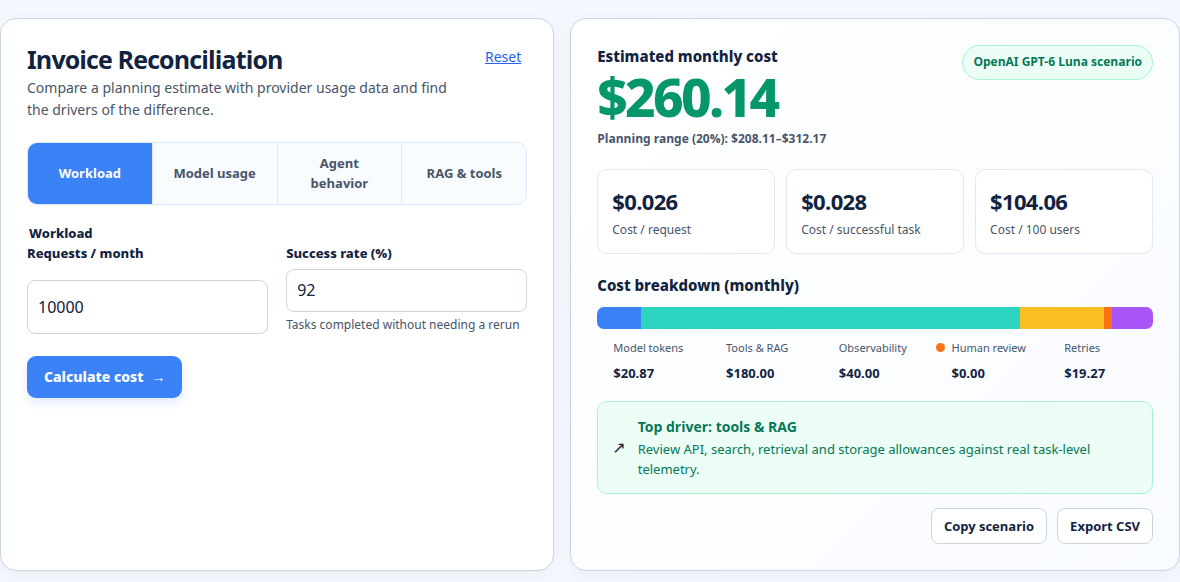
The calculator view is useful for planning, but it does not replace provider evidence. Use the AI API invoice reconciliation calculator to compare an estimate with recorded usage, then attach request-level rows before calling the difference a duplicate charge.
A practical reconciliation workflow
Start with scope. Choose the account, project, provider, model family, currency, and time basis. Submission time, completion time, usage time, and invoice time can put the same attempt in different daily reports. Write the selected UTC window and reporting rule into the reconciliation run.
Next, ingest attempts idempotently. The unique key should normally combine the provider, provider request or resource ID, and the operation type. If a provider does not expose a stable request ID, retain the local attempt ID and treat the match as lower confidence. Never make the prompt text the financial key: identical prompts can be legitimate separate jobs.
Then ingest billing records separately. Keep the provider amount, currency, meter category, invoice period, charge ID, and source file. Parse monetary values as exact decimals or integer minor units. Do not use binary floating-point arithmetic for cents or token-based fractions.
Join in this order:
- Exact provider charge or invoice-row ID.
- Provider request/resource ID plus the matching account and period.
- Local attempt ID plus a documented provider export mapping.
- A review queue for weaker matches based on time, model, units, and amount.
Calculate four totals: confirmed matched charges, unresolved exposure estimates, duplicate-import observations, and unexplained invoice variance. Keep credits, refunds, and adjustments as separate signed events. A negative correction should not overwrite the original charge because the audit trail must show both the original observation and the later correction.
For a recurring audit, measure the number of logical jobs with more than one attempt, the share of attempts with provider IDs, the share of charges matched exactly, pending-age buckets, duplicate-import rate, and unexplained variance by provider and model. These are operational measurements, not promises about savings or billing outcomes.
For model price assumptions, consult the model pricing comparison and keep the price-card date beside the estimate. For token-unit calculations, the AI token cost calculator can help validate input and output arithmetic. A monthly LLM cost calculator is useful for planning, but planning totals should remain distinct from settled invoice rows.
Limitations and exclusions
This ledger proves what your evidence supports; it cannot infer a provider’s internal processing history when no attempt-level record is exposed. A duplicate-looking row may be a real second execution, a repeated export line, a correction, or a late-arriving revision. Escalate ambiguous cases instead of choosing the explanation that makes totals balance.
The example excludes taxes, credits, discounts, cached-input pricing, batch discounts, tool calls, image or audio meters, gateway fees, and customer-facing markup. It also assumes the provider’s amount is in USD and that the assumed token rates apply uniformly. Those are calculation assumptions, not current vendor prices. If the provider reports usage after the invoice closes, carry the record forward as pending and post an adjustment with a reason.
Run your scenario
Turn this framework into an editable estimate.
Use dated, source-linked assumptions and see cost per request, successful task and month.
FAQ
Does every retry create a duplicate AI API charge?
No. A retry creates another execution attempt, but it becomes a separate charge only if the provider records billable work for it. A timeout leaves the remote outcome uncertain. Reconcile the attempt against provider usage or invoice evidence instead of assuming either zero or a duplicate.
How should I represent a retry in an AI API billing ledger?
Keep one logical job_id and one attempt_id per outbound try. Store each attempt’s provider ID, model, timestamps, status, usage, amount, and billing state. Summarize the job only after its attempts have been matched or explicitly left unresolved.
What is the difference between a duplicate charge and a duplicate import?
A duplicate import repeats the same provider charge or invoice-row identity in your local system. A duplicate charge claim requires two distinct provider financial records or authoritative provider confirmation for the same logical work. Deduplicate imports by stable external ID and retain the discarded observation as an audit event.
Can token usage calculate the final invoice amount?
Token usage can produce an estimate when the correct dated price rules and all billable meters are known. It is not automatically the final invoice amount. Cached tokens, batch or service-tier rules, tool usage, taxes, credits, rounding, and later adjustments can change the settled result.
Should billing-limit or quota errors be retried?
Not automatically. OpenAI’s current guidance distinguishes temporary rate-limit or overload recovery from billing, quota, and usage-limit errors that require action.[1] Classify the structured error, record the decision, and retry only when the provider’s guidance and your policy say the condition is transient.
What should an unknown amount mean in reporting?
It should mean that the evidence is incomplete, not that the amount is zero. Keep the attempt visible, record the last lookup time and owner, and show confirmed totals separately from pending or estimated exposure. Close it only when a billing record, a documented zero, or an approved adjustment supports the state change.
Primary sources checked
Pricing and product behavior can change. These sources support the time-sensitive claims in this guide; verify current provider terms before committing spend.