Research-backed calculator guide
Managed vs Self-Hosted Vector Database: Fully Loaded Break-Even
Compare managed and self-hosted vector database TCO with read-unit math, infrastructure labor, HA assumptions, and a worked break-even example.
Quick answer
Managed vector databases are usually the better financial choice while traffic is uncertain, the corpus is small, or your team cannot reliably staff database operations. Self-hosting can become cheaper when the index is large enough that usage-based reads dominate the managed bill, traffic is steady, and you already have capacity for on-call, upgrades, backups, and failure testing. The crossover is not a universal “million vectors” threshold. It is the point where the managed bill for your actual namespace size and query pattern exceeds the fully loaded cost of compute, storage, availability, and labor.
For a screening calculation, model managed cost as storage plus read units, write units, egress, backups, and any plan minimum. Model self-hosted cost as always-on compute, persistent storage, replicas, backup storage, monitoring, network, and the engineering time required to operate it. In the worked example below, a 10 GB namespace receiving 3 million queries per month costs about $515 per month on an illustrative Pinecone Standard calculation, while a deliberately conservative three-node self-hosted estimate is $1,450 per month. At that workload, managed wins. Holding the same query rate and assumptions, the model crosses near 27 GB of namespace data because the documented read-unit rule makes each query more expensive as the namespace grows. That is an estimate, not a quote or a recommendation to migrate.
Pricing observations in this article were checked on November 2, 2026. Pinecone lists Builder at $20 per month, Standard with a $50 monthly minimum, and Enterprise with a $500 monthly minimum. Standard database rates shown on its pricing page include $0.33 per GB-month for storage, $4–$4.50 per million write units, and $16–$18 per million read units, with separate egress, import, backup, and restore meters. [1] Actual plans and rates can change, so re-run the model before making a procurement decision.
What belongs in vector database TCO?
A useful comparison starts by separating the bill from the operating model. “Free” open-source software only removes a license line. It does not remove the machine, disks, replicas, observability, upgrades, incident response, or the opportunity cost of the people doing that work.
Managed cost components
For a managed service, begin with the provider’s billing meters rather than a single advertised starting price. Pinecone documents four core index metrics: read units, write units, storage, and egress. Imports, backups, restores, embeddings, and reranking are separate cost areas. [2]
Read units are often the decisive term. Pinecone’s current documentation says a query uses 1 RU for every 1 GB of namespace size, with a minimum of 0.25 RU per query. A 10 GB namespace therefore consumes about 10 RU per query under that documented model, before multiplying by monthly query count. Fetch, list, full-text search, and response egress follow their own rules. [2] This means two teams with the same number of stored vectors can have very different bills if one searches a larger namespace or sends much more traffic.
Write units cover upserts, updates, and deletes. Re-embedding a corpus is therefore not merely a model-cost event; it also creates a vector-store write workload. A refresh plan should include the expected number of changed records, average record size, and whether updates charge for both the old and new record sizes.
Storage is not the same thing as raw vector bytes. Pinecone’s sizing formula includes IDs, metadata, dense-vector dimensions multiplied by four bytes, and optional sparse-vector data. [2] Index overhead, metadata, replicas, backups, and retained old versions can make a naive “vectors × dimensions” estimate too low.
Self-hosted cost components
Self-hosting shifts the meter from service operations to capacity and responsibility. Compute is normally provisioned continuously if the database must answer interactive requests. AWS describes EC2 On-Demand as compute capacity billed by instance-hour, with per-second billing for many Linux and Windows configurations and a 60-second minimum. [3] That billing model is useful for a first estimate, but a production design also needs headroom for compaction, reindexing, failover, and traffic spikes.
Persistent storage is another separate line. AWS EBS charges for the GB provisioned until the volume is released, with additional IOPS and throughput charges when provisioned above the baseline. [4] A vector index may need more disk than the logical corpus because of index structures, snapshots, temporary build space, and a second copy for recovery. Treating one volume as both live data and the only backup is not a complete TCO model.
Finally, add people. Include setup and migration as one-time cost, then assign a monthly allowance for patching, alert review, performance tuning, backup verification, access reviews, and incident response. If the database is part of a customer-facing RAG system, use the fully loaded engineering rate, not a zero-dollar “we already have engineers” assumption. The staff may be shared, but their time is still scarce.
A hybrid option can change the answer. AWS lists managed services and database extensions such as RDS for PostgreSQL with pgvector alongside purpose-built choices, and emphasizes choosing based on existing infrastructure, technical requirements, performance, scalability, and cost. [5] If PostgreSQL is already paid for and the vector workload is modest, the incremental cost of pgvector can be materially different from deploying a new three-node cluster. That is a third option, not proof that self-hosting a dedicated engine is always cheapest.
Worked cost example: 10 GB versus 100 GB
The following example intentionally exposes its assumptions. It uses USD, a 30-day month, English-US pricing context, and current public Pinecone Standard list rates as shown on November 2, 2026. The self-hosted side is an estimate for comparison, not an AWS quote.
Managed assumptions
- 10 GB namespace, including vectors and metadata.
- 3,000,000 queries per month.
- 500,000 write units per month. Write units are counted directly, not records unless the record-size calculation produces that usage.
- $17 per million read units, the midpoint of Pinecone’s published $16–$18 range.
- $4.25 per million write units, the midpoint of its published $4–$4.50 range.
- $0.33 per GB-month storage.
- 10 GB monthly egress, within the Standard plan’s 100 GB allowance.
- No embeddings, reranking, import, backup, restore, taxes, support add-ons, or cross-region transfer in the base monthly number.
At 10 GB, each query uses approximately 10 RU. Monthly read usage is therefore 3,000,000 × 10 = 30,000,000 RU. The estimated read charge is 30 × $17 = $510. Storage is 10 × $0.33 = $3.30. Write usage is 0.5 × $4.25 = $2.13. The subtotal is $515.43, which is already above the $50 Standard minimum. If you add 200 GB of managed backup at the listed $0.10/GB-month rate, add $20, producing $535.43 before other exclusions. [1] [2]
Self-hosted assumptions
- Three always-on instances at an assumed $0.50 per instance-hour: 3 × $0.50 × 730 hours = $1,095 per month.
- 500 GB of gp3-equivalent persistent storage at an assumed $0.08 per GB-month = $40 per month. AWS uses $0.08/GB-month in one gp3 pricing example, but the exact rate depends on region and configuration. [4]
- Eight hours of platform engineering at an assumed fully loaded $30/hour = $240 per month.
- $75 per month as an explicit allowance for monitoring, snapshots, and routine recovery testing.
- Total estimated self-hosted TCO = $1,450 per month.
The result is not “managed is cheap” or “self-hosting is wasteful.” It says that at 3 million queries per month and a 10 GB namespace, usage-based managed reads are still lower than the assumed cost of three continuously running nodes plus operations. But the self-hosted estimate only works if that cluster can meet latency, durability, and recovery objectives. If it needs six nodes, a separate standby region, premium disks, or more operations time, its cost rises.
| Step | Managed calculation | Self-hosted calculation | Output |
|---|---|---|---|
| Index / capacity | 10 GB namespace | 3 nodes, 730 hours each | Input assumption |
| Read workload | 3M queries × 10 RU | Included in fixed capacity | 30M RU |
| Read / compute | 30M ÷ 1M × $17 | 3 × $0.50 × 730 | $510 / $1,095 |
| Storage | 10 GB × $0.33 | 500 GB × $0.08 | $3.30 / $40 |
| Writes / labor | 0.5M WU × $4.25 | 8 hours × $30 | $2.13 / $240 |
| Operations allowance | Backup excluded from base | Monitoring and snapshots | $0 / $75 |
| Monthly total | $515.43 | $1,450 | Managed lower by ~$934.57 |
Break-even sensitivity
Keeping the query rate at 3 million per month, the approximate managed formula is:
managed monthly cost = (3 × namespace_GB × $17) + (namespace_GB × $0.33) + $2.13
The first term is read units in millions: 3 million queries multiplied by the namespace size in GB. Setting this equal to the $1,450 self-hosted estimate gives a crossover around 27 GB. At 27 GB, the estimated managed cost is about $1,388 for reads, $8.91 for storage, and $2.13 for writes, or roughly $1,399 before optional backup. At 50 GB, the same traffic would be approximately $2,568 for reads plus $16.50 storage and $2.13 writes, or about $2,587 before optional backup. The arithmetic is transparent, but the operating assumptions are not universal.
If traffic is only 300,000 queries per month, the same 10 GB namespace produces about 3 million RU, or $51 in read charges, plus storage and writes. Managed service economics remain close to the plan floor, and a dedicated self-hosted cluster would usually be difficult to justify on cost alone. If traffic rises to 10 million queries per month, a 50 GB namespace produces about 500 million RU; the managed read line alone is approximately $8,500 at the midpoint rate. That is the kind of workload where self-hosting deserves a capacity benchmark, provided the team can fund reliability rather than comparing only software price.
A practical break-even checklist
Before changing architecture, run the model with production evidence:
- Measure namespace size, not just vector count. Include metadata, sparse values, index overhead, and replicas. A 1,536-dimension vector is about 6,144 raw bytes before metadata and indexing, but the final billable footprint depends on the provider’s sizing rules.
- Use real query distributions. Record average and peak queries, namespace or tenant selected, top-k, filters, and response bytes. A single average query can hide a large tenant or a read-heavy feature.
- Count writes during refreshes. Include initial import, daily updates, deletes, re-embedding, and dual-write migration periods. Pinecone lists import, backup, and restore as separate meters from ordinary database usage. [1] [2]
- Right-size self-hosted capacity at the target SLO. Benchmark p95 and p99 latency, recall, concurrent queries, compaction, recovery, and reindexing. AWS notes that compute and EBS are separately priced resources; a low-cost instance plus slow storage is not an equivalent architecture. [3] [4]
- Price labor and failure handling. Add a named owner, on-call coverage, patch cadence, backup restore drills, and incident hours. If nobody can respond to a failed node, the self-hosted estimate is incomplete.
- Test the middle path. If the application already runs PostgreSQL or another search system, price the marginal load of an extension or managed add-on. AWS’s vector-database guidance explicitly presents multiple service and extension patterns rather than a single universal design. [5]
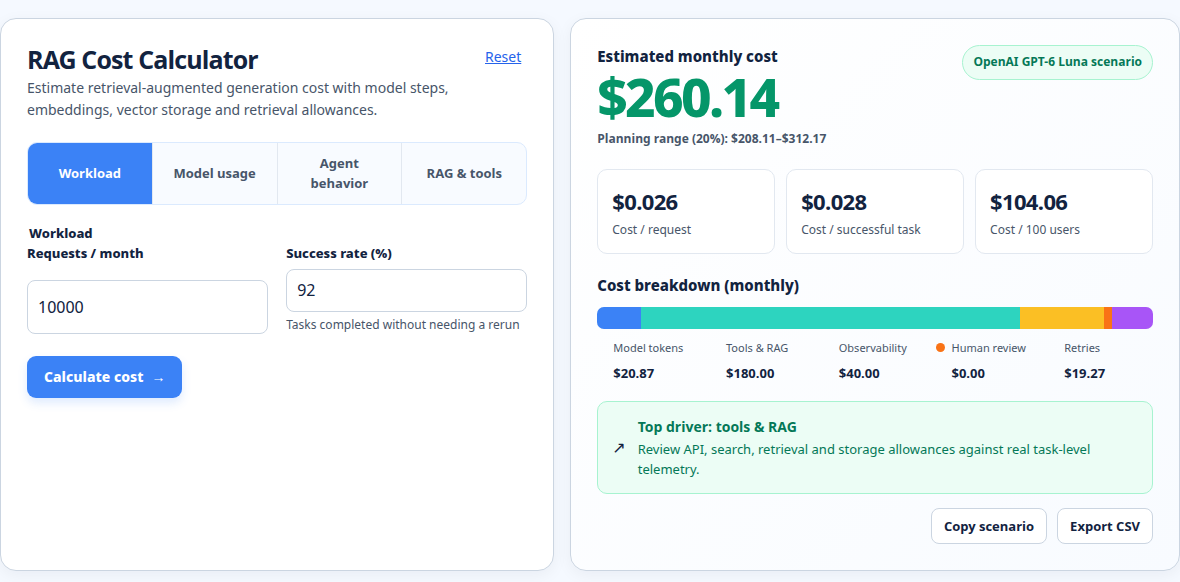
Use the RAG, embedding and vector database cost calculator to organize the workload inputs. If the vector store shares machines with inference, compare the capacity assumptions with the Self-hosted GPU inference cost calculator. For a broader provider and unit comparison, see Model pricing comparison, then reconcile the estimate to actual invoices with the AI API invoice reconciliation calculator.
Run your scenario
Turn this framework into an editable estimate.
Use dated, source-linked assumptions and see cost per request, successful task and month.
FAQ
Is a managed vector database cheaper than self-hosting?
Usually at small or uncertain scale, but not by definition. Managed services charge for convenience through storage and usage meters. Self-hosting can lower unit cost at sustained volume, while adding compute, storage, resilience, and labor. Compare the managed bill with a fully loaded self-hosted TCO, not with the open-source license price.
What is the main driver of managed vector database cost?
For read-heavy workloads, query volume multiplied by the provider’s read-unit rule can dominate storage. Pinecone documents query usage as 1 RU per 1 GB of namespace size, with a 0.25 RU minimum. [2] That makes namespace size and traffic jointly important. Writes, egress, backups, imports, embeddings, reranking, and plan minimums can also matter.
When does self-hosted vector search cost less?
It can cost less when traffic is predictable, the index is large enough that managed read charges exceed fixed capacity, and the organization already has database operations capability. The break-even point moves if you need more replicas, multi-region recovery, premium storage, or additional engineering time. Use the worked formula as a sensitivity model, not as a universal threshold.
Does self-hosted mean the vector database software is free?
Open-source software may have no license fee, but the production system still consumes compute, persistent disks, network, monitoring, backups, security work, upgrades, and human time. If those items are omitted, the comparison is a hosting-cost comparison rather than vector database TCO.
Should a small RAG application self-host its vector database?
Not solely to reduce cost. A small workload may fit in an existing database or a low-minimum managed plan, while a dedicated cluster introduces fixed capacity and operational obligations. Self-hosting can still be justified for data-residency, custom performance, offline operation, or control requirements, but those are architectural benefits rather than automatic savings.
What costs are excluded from the worked example?
The base calculation excludes embeddings, reranking, application compute, LLM generation, taxes, support plans, migration labor, downtime, cross-region replication, cross-region transfer, security tooling, and the cost of unused capacity. It also assumes the illustrative three-node self-hosted design is sufficient. Replace each assumption with measured workload and regional pricing before approving a migration.
Primary sources checked
Pricing and product behavior can change. These sources support the time-sensitive claims in this guide; verify current provider terms before committing spend.