Research-backed calculator guide
OpenRouter Effective Cost Calculator: Model Prices, Credits, BYOK and Routing
Calculate OpenRouter effective cost from model token rates, Standard or Business credit fees, BYOK allowance and routing or cache assumptions.
Quick answer
OpenRouter effective cost is not one universal gateway percentage. Start with the selected model and provider’s token or request prices, then choose the billing route:
Shared-credit cash estimate = model and tool usage × (1 + applicable credit-purchase fee)
Standard currently shows a 5.5% fee on credit purchases and Business shows 8%. Those fees are charged when credits are bought, not on each inference request. OpenRouter says model inference is billed at the provider’s list price without a token markup. Standard and Business BYOK include $25,000 per month of list-price inference with no BYOK fee, then charge 5% on the excess. Enterprise BYOK terms are custom. [1] [2]
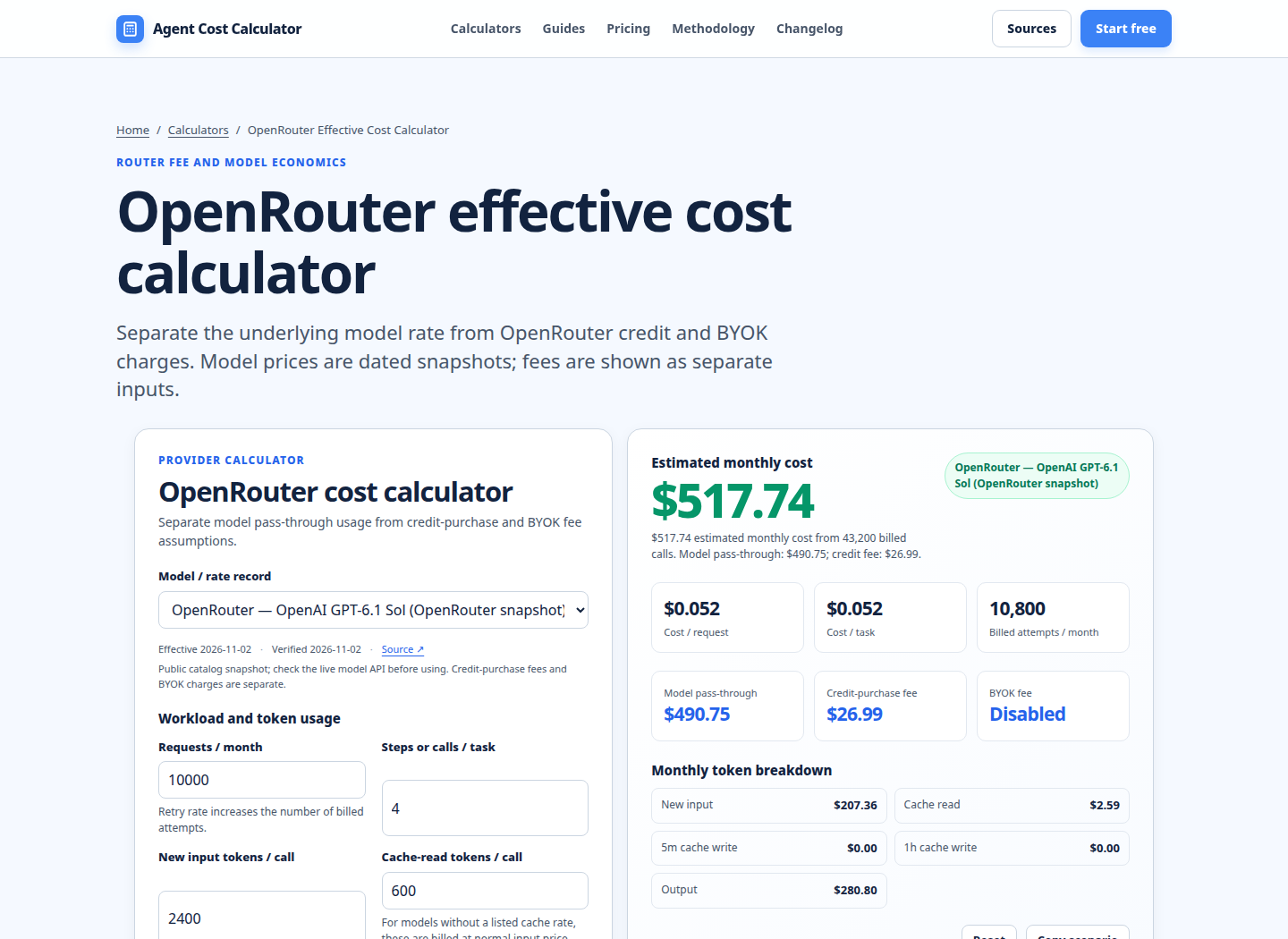
The calculator separates these lines so you can compare a shared-credit route, BYOK, and a custom assumption without pretending that one fee applies to every request.
Run your scenario
Turn this framework into an editable estimate.
Use dated, source-linked assumptions and see cost per request, successful task and month.
What the current search results cover
A dated, English-language web snapshot captured on 2 November 2026 for “OpenRouter effective price calculator” and closely related wording returned a mixed first ten organic result set. It is a locale-limited observation, not a global ranking claim, demand estimate, or statement that any competitor does or does not rank elsewhere.
The formats were mostly interactive calculators, model-comparison tools, GitHub code, and long pricing explainers. Calculators commonly ask for input tokens, output tokens and request volume, then show a sortable model table or a single-model total. The explainers add plan summaries, token examples, caching tips and routing advice. Visuals ranged from calculator tables and product screenshots to diagrams and promotional graphics. Depth varied from a short tool description to a long commercial article with many sections and product CTAs.
The supportable gap is narrower than “no one answers this.” Existing results usually calculate model token spend or explain the 5.5% credit fee. They less consistently put the full decision into one auditable calculation: dated catalog rates, purchase-fee timing, the spend-based BYOK allowance, BYOK overage, cache read or write treatment, and the fact that provider routing can change the effective price and cache hit rate. This guide and calculator address that combination. The underlying data remains time-sensitive, so the result is an estimate rather than a vendor quote.
OpenRouter model prices are a dated catalog snapshot
OpenRouter’s public model API exposes per-model pricing fields, including prompt, completion, cached-input and sometimes cache-write or per-request prices. [3] The API documentation describes the endpoint as a list of models available through the API; it does not turn the catalog into a permanent price lock. [7]
For a text workload, the basic calculation is:
Base model cost = (input tokens ÷ 1,000,000 × prompt rate) + (output tokens ÷ 1,000,000 × completion rate)
Add cached-input tokens, cache-write tokens, reasoning tokens, image or audio units, web search, file parsing and other per-request meters when the selected model or route exposes them. Do not replace an unknown meter with zero. A model can have a low prompt rate but a relatively expensive completion rate, or a separate rate after a context threshold.
As a dated 2 November 2026 snapshot in the project rate records, OpenRouter lists GPT-6.1 Sol at $2 per million input tokens, $0.10 per million cached input tokens, $2.50 per million cache-write tokens and $10 per million output tokens. The same snapshot lists Claude Sonnet 5.5 at $2 input, $0.10 cached input, $2.50 for a five-minute cache write, $4 for a one-hour cache write and $10 output; Gemini 4 Argon at $2 input, $0.10 cached input and $10 output; and DeepSeek V4.1 Flash at $0.30 input, $0.006 cached input and $1.20 output. These are catalog records, not a promise that every provider endpoint, variant or future model version will use the same rates. [3]
If the price changes after you budget, OpenRouter’s pricing page says requests continue at the new rate and credits are deducted accordingly. Pin an explicit model ID when reproducibility matters, then record the verification date beside your forecast. [1]
Credit fees: when they apply and when they do not
On the shared-credit route, you buy credits and requests deduct their model cost from the balance. The current plan page lists 5.5% for Standard and 8% for Business. The fee is a funding event, not a second per-request token markup. Model rates are the provider’s list prices on every plan. [1]
The official FAQ also contains fee wording that can differ by payment method and page version. Check the account checkout before a small top-up or crypto purchase. Do not turn a conditional minimum or payment-specific rule into a universal percentage. The practical distinction remains stable: a credit-purchase fee is not a fee on every inference route. [2]
Errors and fallback attempts also need care. The current pricing page says an attempt that errors is not charged for its model tokens; auxiliary services that already ran, such as web search or file parsing, may still be billed. A successful fallback can therefore change the provider, cache state and final price even when the failed attempt’s model tokens are not charged. [1]
BYOK: a separate provider bill and a spend allowance
BYOK means OpenRouter routes through your provider key while your provider bills the inference. The BYOK guide says the OpenRouter charge is 5% of what the same model and provider would normally cost on OpenRouter, deducted from OpenRouter credits, after the plan-dependent free allowance. Standard and Business include $25,000 per month of list-price inference with no BYOK fee; Enterprise is custom. The allowance is measured in dollars of list-price inference, not request count. [1] [4]
The BYOK formula is:
BYOK OpenRouter fee = max(0, monthly list-price inference − $25,000) × 5%
If monthly list-price BYOK inference is $30,000, the excess is $5,000 and the OpenRouter BYOK fee is $250. The provider’s $30,000 invoice remains separate. If you fund the $250 OpenRouter fee with Standard credits, add the applicable credit-purchase fee to that funding line; do not add a shared-credit fee to the entire $30,000 provider bill.
BYOK routing can still fall back to shared capacity. A prioritized key is normally tried first, but a failure or rate limit can move the request to another key or shared endpoint. BYOK settings can instead forbid shared capacity for selected models or an entire provider; that may produce an error rather than silently spend OpenRouter credits. [4]
Routing and cache can change the effective price
Default routing is not simply “pick the cheapest listed endpoint.” OpenRouter says it considers effective price, throughput, time to first token, rate limits, reliability and quality signals. Providers near the best combined result receive most traffic, with weighted selection and fallback behavior. You can override that policy with provider order, allowed or ignored providers, price sorting, throughput or latency sorting, performance preferences, or a maximum price. [5]
That distinction matters in a calculator. A route sorted by price may not be the route with the lowest cost per accepted result if it is slower, rate-limited, less reliable or produces more retries. Conversely, a faster provider can be economically preferable when waiting time or failed jobs has an operational cost. The calculator’s price result is therefore a base estimate; routing policy and outcome quality belong in your scenario notes.
Prompt caching also differs by provider and model. OpenRouter’s catalog can expose cache-read and cache-write prices, while the prompt-caching guide documents provider-specific behavior. For example, Claude cache writes can use five-minute or one-hour TTLs with different write rates, while cache reads are discounted. DeepSeek uses automated caching with its own cache-read treatment. [3] [6]
OpenRouter uses provider sticky routing after caching to keep subsequent requests for the same model and conversation on the same provider while the cache is warm. A sticky session expires after ten minutes of inactivity, and an explicit provider order takes priority. Use cached-token and cache-write usage rather than a guessed hit percentage. [6]
Worked scenario: one workload, three billing routes
Assumptions, not a quote: 1,000,000 uncached input tokens, 250,000 output tokens, no tools, no retries, no taxes, and the dated GPT-6.1 Sol catalog rates above. Assume a 30-day reporting period and that a single Standard credit purchase funds the shared-credit case.
- Model usage: input is 1,000,000 ÷ 1,000,000 × $2 = $2.00. Output is 250,000 ÷ 1,000,000 × $10 = $2.50. Base inference is $4.50.
- Standard shared credits: allocate 5.5% of $4.50, or $0.2475, to the purchase event. Estimated cash requirement is $4.7475, rounded to about $4.75, before tax or checkout-specific rules.
- Business shared credits: allocate 8% of $4.50, or $0.36. Estimated cash requirement is $4.86.
- Standard BYOK inside allowance: the provider bill is $4.50. The OpenRouter BYOK fee is $0 because the monthly list-price total is below $25,000. No OpenRouter credit-purchase fee is added to the provider bill.
The shared-credit comparison allocates the cost of buying credits; it does not mean every inference request receives a second 5.5% or 8% token markup. BYOK moves the model invoice to the provider and applies the allowance rule to OpenRouter’s fee.
Formula and exclusions
Use this full planning structure when your trace contains more than plain text:
Effective cash = model meters + tool meters + allocated credit fee + BYOK overage fee
Model meters include prompt, cached input, cache writes, completion, reasoning, image or audio and per-request charges shown for the selected model. Add retries only when they consume billable work or auxiliary services. Keep tax, refunds, unused-credit expiry, enterprise terms, direct-provider commitments, labor, latency value, quality review and infrastructure outside the token result unless entered as explicit assumptions.
The calculator does not guarantee a provider, cache hit, latency percentile, success rate or future price. Use the model pricing comparison for a shared workload across dated records, the LLM cost calculator for broader token scenarios, and invoice reconciliation after production usage is available.
FAQ
Does OpenRouter add a markup to every model token?
No. OpenRouter says model inference is billed at the provider’s list price. Standard’s 5.5% and Business’s 8% fees are charged when credits are purchased, while BYOK has its own 5% overage rule after the included allowance. [1] [2]
Is the $25,000 BYOK allowance based on requests?
No. It is measured by monthly list-price inference cost. Standard and Business include $25,000 per month; usage above that amount carries a 5% fee. Enterprise allowances are custom. [1] [4]
Can routing make the final cost different from the model-page price?
Yes. The provider endpoint, cache state, routing variant, per-request meter, fallback and current price can change the billed result. Default routing also weighs throughput, latency, reliability, rate limits and quality rather than price alone. [3] [5]
Does prompt caching always reduce cost?
No. It depends on the provider, model, prompt length, cache-write price, TTL, cache hit rate and routing continuity. Check cached-token and cache-write usage. A manual provider order can take priority over sticky cache routing. [6]
Are failed fallback attempts charged twice?
The current pricing page says an errored attempt is not charged for its model tokens, although auxiliary services that already ran may still be billed. A successful fallback can still use a different provider and price. [1]
Is the calculator a quote?
No. It is a dated planning estimate based on public catalog fields and editable assumptions. Recheck the live model API, account plan, checkout fee, provider key policy and invoice before approving spend.
Primary sources checked
Pricing and product behavior can change. These sources support the time-sensitive claims in this guide; verify current provider terms before committing spend.