Research-backed calculator guide
RAG Document Updates: When Metadata Changes Need No Re-Embedding
Learn when a RAG document update needs new embeddings, when metadata can be changed in place, and how to estimate embedding, vector-write, delete, and validation cost.
A RAG document update does not automatically mean that the whole document, or the whole index, must be re-embedded. The cost depends on what changed and on how your ingestion pipeline identifies that change. A metadata-only change can usually update existing records in place. A text change normally requires re-parsing and re-embedding the affected chunks. A change to the embedding model, vector dimensions, or chunking policy can require a much wider rebuild.
Quick answer
Use this decision rule for RAG document update cost re-embedding:
- Metadata only: Do not call the embedding model when the chunk text and embedding remain valid. Update fields such as
document_status, ACL, source URL, title, or effective date in the vector store, then verify filters and access rules. - Text changed inside a chunk: Re-parse and re-embed that chunk. Replace the old vector using a stable chunk ID, or delete the old ID before inserting the replacement if your store does not provide safe overwrite semantics.
- Text changed across a section: Re-chunk the affected section and re-embed every new or changed chunk. Neighboring chunks may need attention when your chunker uses overlap or document-level context.
- Embedding model, dimension, or similarity contract changed: Plan a broad migration. Old and new vectors are not interchangeable just because the source text is unchanged.
- Deletion: Remove the document’s vector records and any derived metadata. A deleted source that remains searchable is a freshness and correctness defect, not a cheap update.
The simplest cost formula is:
update cost = embedding cost + vector writes + vector deletes + validation + temporary overlap/storage + application labor
The embedding API line is only one part of that total. An update that avoids embedding calls may still consume write operations, filter updates, index propagation time, validation queries, and rollback capacity.
What actually changes in a RAG update?
A typical ingestion record has at least four separable parts: the source document, the normalized chunk text, the embedding vector, and metadata used for filtering or display. Treating all four as one object creates unnecessary work. A title, owner, retention label, or access-control value can change while the chunk text remains identical. In that case, the semantic representation has not changed.
Pinecone’s update documentation describes updating a record by ID with new vector values, metadata, or both. It also describes changing only selected metadata fields, including across records matched by a metadata filter. That is the operational basis for a metadata-only path: preserve the vector and change the filterable fields. [1]
Amazon Bedrock documents a similar distinction for a managed ingestion flow. Its normal resync handles changed content by parsing, chunking, generating embeddings, and indexing. It also documents a metadata-only optimization for qualifying metadata.json changes: existing embeddings can be retrieved, metadata merged, and the updated records written without calls to the embedding model. The conditions matter. A content file change, a CSV case, or a custom transformation can move the update back onto a re-ingestion path. [2]
That distinction is useful even when you do not use either product. Keep a content hash and a metadata hash per source version. Compare them before ingestion, and route the event to one of four jobs: metadata patch, changed-chunk re-embedding, delete, or migration rebuild.
A practical change-type matrix
| Change detected | Re-embed? | Vector-store work | Main validation | Cost risk |
|---|---|---|---|---|
| ACL, title, tag, URL, or status only | No, if chunk text is unchanged | Metadata update by stable IDs or filter | Filtered retrieval and access-control test | Stale filters or unauthorized retrieval |
| One chunk’s text changed | Yes, changed chunk only | Upsert replacement; optionally delete old ID | Query terms that should find the revised passage | Missed changed chunk or duplicate ID |
| Paragraph length changes chunk boundaries | Usually yes for affected window | Delete superseded IDs and write new IDs | Recall around the edit and neighboring chunks | Overlap causes wider-than-expected work |
| Embedding model or dimensions change | Yes, broad migration | Dual index, backfill, cutover, cleanup | Recall, similarity thresholds, latency | Double storage and inconsistent query vectors |
| Source document deleted | No embedding call | Delete all chunk IDs and metadata | Negative query and count check | Ghost results and retention violations |
The table is a routing model, not a guarantee for every vendor. Check the semantics of your vector database, integrated embedding option, chunker, and ACL implementation before automating it.
When should you re-embed a document?
Re-embed when the text used to create a vector has changed materially enough that the old vector no longer represents the retrievable meaning. “Materially” is an application rule. A corrected number, changed eligibility condition, new product limit, or removed paragraph should be treated as semantic content. A cosmetic HTML class or a display-only label usually should not.
Do not use a raw document-level timestamp as the only trigger. It cannot tell whether content, metadata, or an irrelevant export field changed. Normalize the source first, remove volatile fields, split it using the same chunking policy, and hash the resulting chunk text. Stable IDs can be formed from a document ID, logical section ID, and chunk sequence. If a chunk hash is unchanged, retain its vector. If it differs, re-embed that chunk and update its version.
Chunk boundaries complicate the “only one chunk changed” assumption. Suppose a sentence is inserted near the beginning of a document and your chunker numbers chunks sequentially. Every later chunk may receive a new number even when its text is unchanged. Prefer content-addressed or stable logical IDs, and compare normalized chunk text rather than sequence number alone. If the insertion shifts overlapping context, re-embed the affected overlap window and measure retrieval quality around the edit.
A full rebuild is more defensible when you change the embedding model, vector dimensionality, distance metric assumptions, language normalization, chunk size, overlap, or the text cleaning rules that define what gets embedded. OpenAI explains that embeddings are vectors whose distances represent relatedness, that input is billed by token count, and that embedding models have specific vector lengths that can be adjusted with a dimensions parameter. Those properties make model and dimension changes a compatibility event, not a metadata patch. [3]
Worked cost example
Assume a knowledge base has 10,000 stored chunks, each averaging 800 input tokens. A weekly source review finds that 2% of chunks changed, or 200 chunks. The team uses an illustrative embedding rate of $0.10 per 1 million input tokens. This is a planning assumption, not a vendor quote. It excludes taxes, discounts, batch pricing, retries, and any vector database charges.
| Step | Full re-embedding | Changed-chunk update |
|---|---|---|
| Chunks sent to embedding model | 10,000 | 200 |
| Input tokens | 8,000,000 | 160,000 |
| Assumed embedding rate | $0.10 / 1M tokens | $0.10 / 1M tokens |
| Embedding API estimate | $0.80 | $0.016 |
| Vector writes | 10,000 replacements | 200 replacements |
| Deletes | 0 if IDs overwrite safely | 0 if IDs overwrite safely |
| Validation query set | Full regression suite | Changed-topic and neighboring-chunk suite |
The arithmetic is 8,000,000 / 1,000,000 × $0.10 = $0.80 for a full pass and 160,000 / 1,000,000 × $0.10 = $0.016 for the changed chunks. The illustrative embedding-line difference is $0.784 per run, or a 98% reduction in embedding tokens under these assumptions. It is not a promised total saving because the database may meter writes, minimum plans, storage, reads, or egress separately.
If the 200 changed chunks are replacement records and each old record must be deleted first, add 200 deletes to the update path. If a migration keeps both an old and new index for a week, add temporary storage and duplicate write capacity. If validation samples 40 changed chunks and 20 neighboring chunks, record that query and evaluation work as an operating cost even though it is not an embedding charge.
The example also shows why “no re-embedding” is not the same as “zero cost.” A metadata-only update may touch 10,000 records, depending on how broad the filter is. A change to a tenant ACL may require a large metadata update and a permission regression test. Conversely, a 200-chunk semantic update may be cheap at the embedding layer but expensive if it invalidates a cached answer or triggers a dual-index rollout.
!RAG calculator showing separate workload, model, tools, vector storage, read, write, and egress cost controls
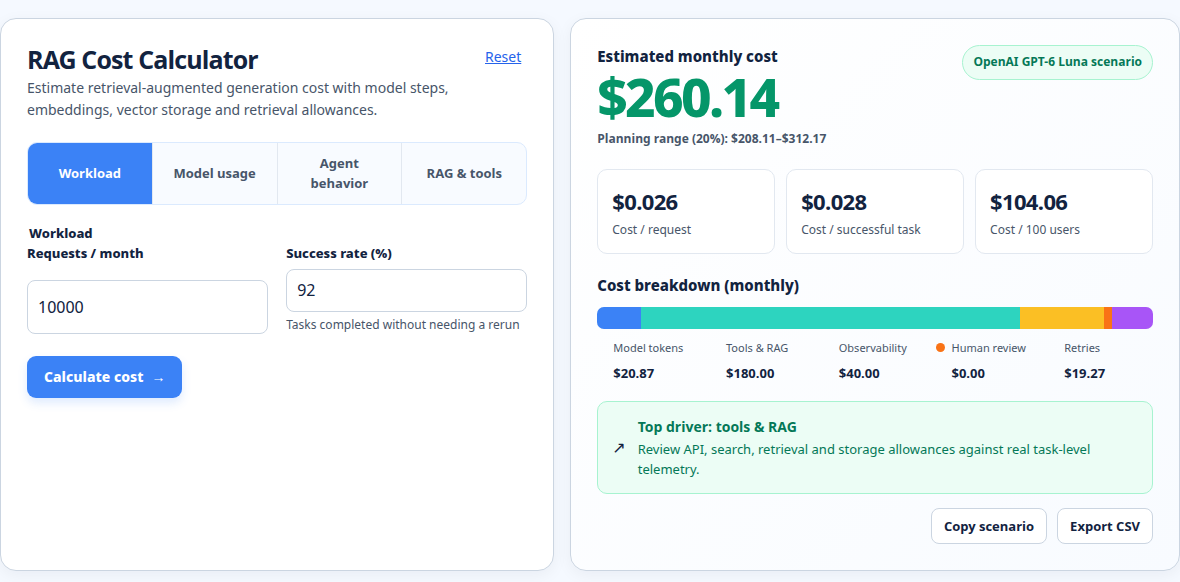
Use the RAG, embedding and vector database cost calculator to keep document ingestion separate from query-time spend. Enter changed or re-embedded documents per month rather than silently treating every query as a corpus refresh. For infrastructure comparisons, the Self-hosted GPU inference cost calculator is a separate question: it can help price compute, but it does not replace the embedding and vector-store ledger above.
A safe update workflow
Start by recording an immutable source version and a deterministic normalized representation. Store the document ID, source version, chunk ID, chunk hash, embedding model, vector dimensions, and metadata version. The record should make it possible to answer, “Which vector represents which text and policy version?” without reconstructing history from logs.
Next, classify the diff before calling an embedding API. If only metadata changed, issue a metadata update. Pinecone notes that an update can change selected metadata fields without replacing the vector, while its upsert reference says an existing vector ID is overwritten by a new upsert. The distinction matters: a partial metadata update preserves fields, whereas a full upsert must include the intended complete record state. [1]
For semantic changes, produce new chunk IDs or deterministic replacements. Write to a staging namespace or versioned index when correctness matters more than minimum write cost. Validate with queries whose expected answers depend on the changed passage. Check both positive cases, where the new content must be found, and negative cases, where deleted or superseded text must no longer be retrieved.
Finally, make retries idempotent. A failed batch should be safe to resume. Keep an update manifest with source version, changed IDs, written IDs, deleted IDs, validation status, and rollback target. This turns a one-off script into an auditable ingestion operation and makes the cost calculation reconcilable against provider usage and vector-database usage. The AI API invoice reconciliation calculator can help compare the estimate with actual usage rows after the run.
What to include in the cost model
Count embedding input tokens for changed chunks, not only documents. Count vector writes and deletes using your provider’s units. Include read or query work for validation, temporary dual-index storage, data-transfer charges, orchestration compute, retries, and human review for low-confidence diffs. If your vendor has a monthly minimum, model it as a floor or plan condition rather than adding it twice to usage-based lines.
Separate estimates from quotes. A formula based on your measured average chunk size is an estimate. A provider’s current rate card is a published price, still subject to account terms and change. Your invoice is the evidence for what was actually charged. Record the currency, token unit, date checked, model, region, service tier, and whether batch or discounts apply.
Do not optimize only for the smallest embedding bill. A metadata-only path that leaves stale permissions is not a saving. A changed-chunk path that silently leaves duplicate vectors can reduce relevance. The right target is the lowest update cost that preserves freshness, access control, retrieval quality, and a recoverable rollback path.
FAQ
Does every RAG document edit require re-embedding?
No. If the embedded chunk text is unchanged and only metadata changes, update the metadata in place when your vector store supports it. Re-embed when the normalized text, chunk context, embedding model, dimensions, or embedding-related preprocessing changes.
How can I update RAG documents without re-embedding?
Normalize the source, hash the resulting chunk text, and compare the new hash with the stored hash. For unchanged chunks, keep the vector. For metadata-only changes, patch metadata by stable chunk IDs or a controlled filter. Then run retrieval and access-control checks. Do not use this shortcut when a content change is hidden inside a volatile field that your normalizer discards.
Is an upsert cheaper than re-embedding?
An upsert is a vector-store write operation, not a substitute for generating a new vector. If you already have a valid replacement vector, upsert can replace the record. If the text changed, you still need the embedding call first. Compare embedding tokens, write units, deletes, retries, and validation rather than comparing the words “upsert” and “re-embed.”
When is a full re-embedding justified?
A broad re-embedding is justified when the embedding model or vector dimensions change, when chunking or normalization changes across the corpus, or when a quality audit shows systematic drift that cannot be isolated to changed chunks. Use a dual-index or staged migration when you need rollback and side-by-side evaluation.
What happens when a document is deleted?
Delete every vector and derived metadata record associated with the document, then test a query that previously returned it. Deletion normally needs no embedding call, but it is not complete until stale records, caches, and access-control references are handled.
How accurate is a re-embedding cost estimate?
It is only as accurate as its token counts, change detection, provider meters, and operational assumptions. Start with observed chunk-token distributions and actual changed-chunk rates. Label model prices and vector-store rates with their checked date, then reconcile the run against usage and invoice data.
Run your scenario
Turn this framework into an editable estimate.
Use dated, source-linked assumptions and see cost per request, successful task and month.
Primary sources checked
Pricing and product behavior can change. These sources support the time-sensitive claims in this guide; verify current provider terms before committing spend.