Research-backed calculator guide
Mistral and Groq API Cost: Tokens, Embeddings, OCR and Audio Units
Compare Mistral and Groq API costs across text tokens, embeddings, OCR pages, transcription minutes, audio hours, generated characters, and voice-agent minutes with dated first-party rates.
Quick answer
Mistral and Groq API cost cannot be reduced to one “price per token.” On the 2 November 2026 source snapshot, Mistral Small 4 is listed at $0.15 per million input tokens and $0.60 per million output tokens. Mistral Large 4 is $0.70 input and $2.10 output, with $0.07 cached input per million tokens. Groq lists GPT OSS 20B at $0.075 input and $0.30 output, and GPT OSS 120B at $0.15 input and $0.60 output per million tokens. [1] [2]
Those are text-token rates only. Mistral separately lists Mistral Embed at $0.10 per million input tokens, OCR 4.1 at $4 per 1,000 pages, Voxtral Mini Transcribe 3 at $0.0035 per audio minute, Voxtral TTS 3 at $13 per million characters, and Voice Agents at $0.04 per conversation minute for Mistral Small 4. Groq lists Whisper Large V3 at $0.111 per audio hour and Whisper Large V3 Turbo at $0.04 per hour. [1] [2]
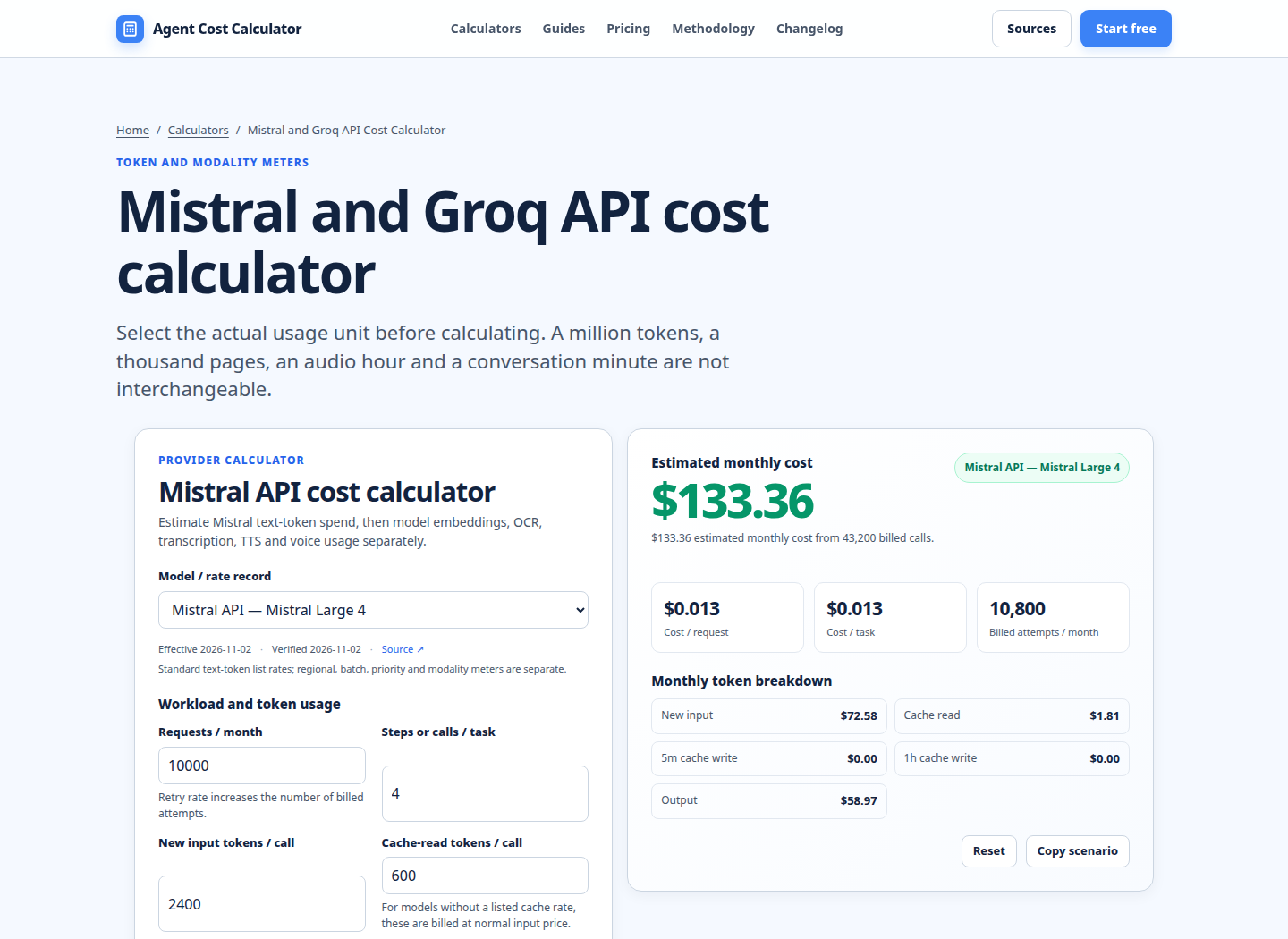
Use the Mistral and Groq cost calculator when the workload includes more than a chat completion. It keeps tokens, embedding tokens, pages, minutes, hours, characters, and quote-only models in separate lines instead of silently treating unlike units as equivalent.
What the dated search snapshot shows
A locale-limited search snapshot taken on 2 November 2026 for the primary query returned a mixture of single-provider calculators, multi-provider comparison tools, spreadsheet-style calculators, and longer pricing guides. The calculator pages generally ask for input and output tokens, requests, users, or response length. The editorial pages add model tables, example bills, caching notes, or a self-hosting comparison.
Depth and freshness vary. Some results expose a visible October or November 2026 update or source-check date. Others present older model names or rates without a clear verification date. Visuals are mostly tables and interactive form controls rather than workflow diagrams. The more detailed pages explain token formulas and retries, but the sampled tools are primarily text-token estimators.
The supportable gap is narrower than “no one covers this topic.” The snapshot does show competing calculators and guides. What it does not consistently combine is a dated, first-party-linked comparison of two providers that preserves OCR pages, embeddings, audio minutes or hours, generated characters, and conversation minutes as distinct meters. It also needs to distinguish a public rate from a model marked Contact Sales. That is the decision this guide and its calculator address. The observation is limited to this date and result set; it is not a claim about worldwide rankings or permanent competitor absence.
Current Mistral and Groq rate cards
The following are USD public-list-rate records checked on 2 November 2026. They are planning inputs, not a quote. Provider pricing, model IDs, account tiers, processing modes, regions, and contract terms can change. [1] [2]
| Meter | Mistral record | Groq record |
|---|---|---|
| Text input | Small 4: $0.15/M; Large 4: $0.70/M | GPT OSS 20B: $0.075/M; GPT OSS 120B: $0.15/M |
| Text output | Small 4: $0.60/M; Large 4: $2.10/M | GPT OSS 20B: $0.30/M; GPT OSS 120B: $0.60/M |
| Cached input | Small 4: $0.015/M; Large 4: $0.07/M | No discounted cached-input record used here |
| Embeddings | Mistral Embed: $0.10/M input tokens | No matching public embedding rate in the cited production table |
| OCR | OCR 4.1: $4/1,000 pages; OCR 3: $2/1,000 pages | No matching OCR page rate in the cited table |
| Transcription | Voxtral Mini Transcribe 3: $0.0035/minute | Whisper Large V3: $0.111/hour; Turbo: $0.04/hour |
| Speech generation | Voxtral TTS 3: $13/M characters | The cited table does not provide a comparable public TTS record |
| Voice agent | Small 4: $0.04/conversation minute; larger models: $0.08/minute | No comparable voice-agent minute record in the cited table |
Mistral’s pricing page organizes these records by model family and modality. Its OCR section labels prices per 1,000 pages, its embedding section labels prices per million tokens, and its audio section includes minute- and character-based records. [1] Groq’s supported-model page uses a production-model table with per-million-token prices for text models and per-hour prices for Whisper. It also labels some production models Contact Sales and separates preview models from production models. [2]
That difference is about product surface, not just arithmetic. Embedding endpoints transform text into vectors, so their billable input is not a generated answer. OCR processes document pages, whether the page contains little or much extracted text. Speech recognition processes elapsed audio, while TTS produces characters. Voice agents can bundle a live conversation into a minute-based product meter. A provider may offer one modality directly and another only through a different product, model, or commercial tier.
Do not convert every unit into tokens unless the provider explicitly defines that billing rule. Do not enter a missing Groq OCR or embedding rate as zero. A missing public record means the calculator should use a custom account rate, another documented service, or an explicit “not priced in this snapshot” note.
The formulas behind the estimate
For standard text usage, use separate input and output lines:
Text cost = (input tokens ÷ 1,000,000 × input rate) + (output tokens ÷ 1,000,000 × output rate)
If a provider publishes cached input, split the input total before applying rates:
Text cost = (uncached input ÷ 1,000,000 × input rate) + (cached input ÷ 1,000,000 × cache rate) + (output ÷ 1,000,000 × output rate)
Cached tokens are a subset of input tokens, not an additional bucket. Use observed cache-hit usage when available. A repeated system prompt is not automatically a cache hit, and a provider’s eligibility rules can differ by endpoint or model.
For modality lines, retain the provider’s unit:
- Embedding cost = embedding input tokens ÷ 1,000,000 × embedding rate.
- OCR cost = pages ÷ 1,000 × page rate.
- Transcription cost = audio minutes × minute rate, or audio hours × hourly rate.
- TTS cost = generated characters ÷ 1,000,000 × character rate.
- Voice-agent cost = conversation minutes × minute rate.
Add the lines only when the workflow actually uses them. API keys, taxes, negotiated discounts, storage, vector databases, retrieval, reranking, web search, observability, network transfer, rate-limit upgrades, and human review are outside these provider-meter calculations unless you enter them separately. For a broader retrieval budget, use the RAG cost calculator; for a token-only workload, see the AI Token Cost Calculator.
Worked scenario: one document-and-audio workflow
Assumptions, deliberately illustrative: 2,000,000 Mistral or Groq text input tokens per month; 500,000 output tokens; 20,000,000 embedding input tokens; 1,000 OCR pages; 120 minutes of audio transcription; and 100,000 generated TTS characters. These are workload assumptions, not provider benchmarks. The comparison holds quantities constant but does not assume equal model quality or feature parity.
For a Mistral route using Small 4, Mistral Embed, OCR 4.1, Voxtral Mini Transcribe 3, and Voxtral TTS 3:
- Text: 2 × $0.15 + 0.5 × $0.60 = $0.60.
- Embeddings: 20 × $0.10 = $2.00.
- OCR: 1,000 ÷ 1,000 × $4 = $4.00.
- Transcription: 120 × $0.0035 = $0.42.
- TTS: 0.1 × $13 = $1.30.
- Illustrative Mistral subtotal: $8.32 per month.
For a Groq route using GPT OSS 20B and Whisper Large V3 Turbo:
- Text: 2 × $0.075 + 0.5 × $0.30 = $0.30.
- Transcription: 120 minutes ÷ 60 × $0.04 = $0.08.
- Publicly priced Groq subtotal for these two listed lines: $0.38 per month.
The Groq subtotal is not a complete equivalent of the Mistral workflow. The cited Groq model table does not provide matching public OCR, embedding, or TTS records, so the scenario does not invent those costs or call them free. [2] If your Groq architecture uses another document, embedding, or speech service, add that service’s current rate. Conversely, if your Mistral workflow uses only chat, the Mistral modality lines do not belong in its estimate.
This example also does not answer which provider is better. The providers expose different model sets and endpoint meters, and a lower subtotal can reflect omitted functionality rather than a lower cost for the same accepted result. Compare quality, latency, context behavior, retries, rate limits, and successful task outcomes in a controlled test before switching. Price alone is not a same-quality benchmark.
Run your scenario
Turn this framework into an editable estimate.
Use dated, source-linked assumptions and see cost per request, successful task and month.
Availability, freshness, and exclusions
Groq’s production table includes public prices for GPT OSS 20B, GPT OSS 120B, and Whisper models, while some other production entries are marked Contact Sales. The calculator does not guess a number for a quote-only model. Enter a documented account price in a custom field or treat the option as quote-required. Preview status is also a deployment consideration: a preview model is not the same availability promise as a production model. [2]
Mistral’s page includes more than the selected records above, including additional generalist, audio, code, and embedding entries. [1] A calculator snapshot is not a substitute for checking the provider page when you deploy. Recheck the model ID, region or processing mode, cached-input eligibility, effective date, and whether the endpoint bills by tokens, pages, minutes, hours, or characters.
For invoice reconciliation, compare the calculator’s same-period usage quantities with provider usage exports before adding tax, credits, or fixed charges. The invoice reconciliation guide is useful when your expected subtotal and billed subtotal diverge. For a broader cross-provider view that keeps workload assumptions constant, use Model Pricing Comparison.
FAQ
Is Groq always cheaper than Mistral for text tokens?
Not as a universal conclusion. In this dated snapshot, the listed Groq GPT OSS rates are lower than the selected Mistral Small 4 rates for equivalent input and output token quantities. That comparison does not establish equal quality, latency, limits, availability, or cost per successful task. Run a controlled workload benchmark before choosing.
Can I compare Mistral OCR with Groq Whisper?
No. OCR pages and audio transcription hours measure different work. You can put both lines in an end-to-end budget when your workflow uses both, but you should not call one unit cheaper than the other without defining the business output being compared.
Does Mistral embedding cost include vector storage?
No. The Mistral Embed rate is for embedding input tokens. Vector database storage, reads, writes, retrieval, reranking, and egress are separate costs. Add those services through the RAG model rather than hiding them inside the embedding rate.
Are cached input tokens free?
No. Mistral’s cited rates show discounted cached-input prices for the selected text models, not a zero price. Apply the cache rate only to eligible cached tokens and charge the remaining input at the normal input rate. The Groq records used here do not include a discounted cached-input rate.
What if my Groq model says Contact Sales?
Do not estimate it with a neighboring model’s rate. Contact Sales means the public page does not provide the self-serve number needed for a defensible list-rate calculation. Use a current quote or select a publicly priced model, and keep the assumption labeled.
Does this calculator predict my invoice?
No. It is a scenario estimate based on dated public rates and your quantities. Taxes, credits, contracts, service tiers, regional terms, retries, failed requests, storage, tools, and other meters can change the billed amount.
Primary sources checked
Pricing and product behavior can change. These sources support the time-sensitive claims in this guide; verify current provider terms before committing spend.